Holt Antiques at Walsingham Mill
Tower of London Interest - A Large, Rare, 19th Century Antique Brass Padlock, Bearing the Impressed Mark "Tower of London", "Raven Pen No.2." & Crown Proof Mark
Tower of London Interest - A Large, Rare, 19th Century Antique Brass Padlock, Bearing the Impressed Mark "Tower of London", "Raven Pen No.2." & Crown Proof Mark
Proud to be members of


Couldn't load pickup availability
A rare and evocative 19th‑century antique brass padlock, crisply stamped “Tower of London” and “Raven Pen No.2”, offering a direct and atmospheric link to one of Britain’s most enduring legends: the Ravens of the Tower of London.
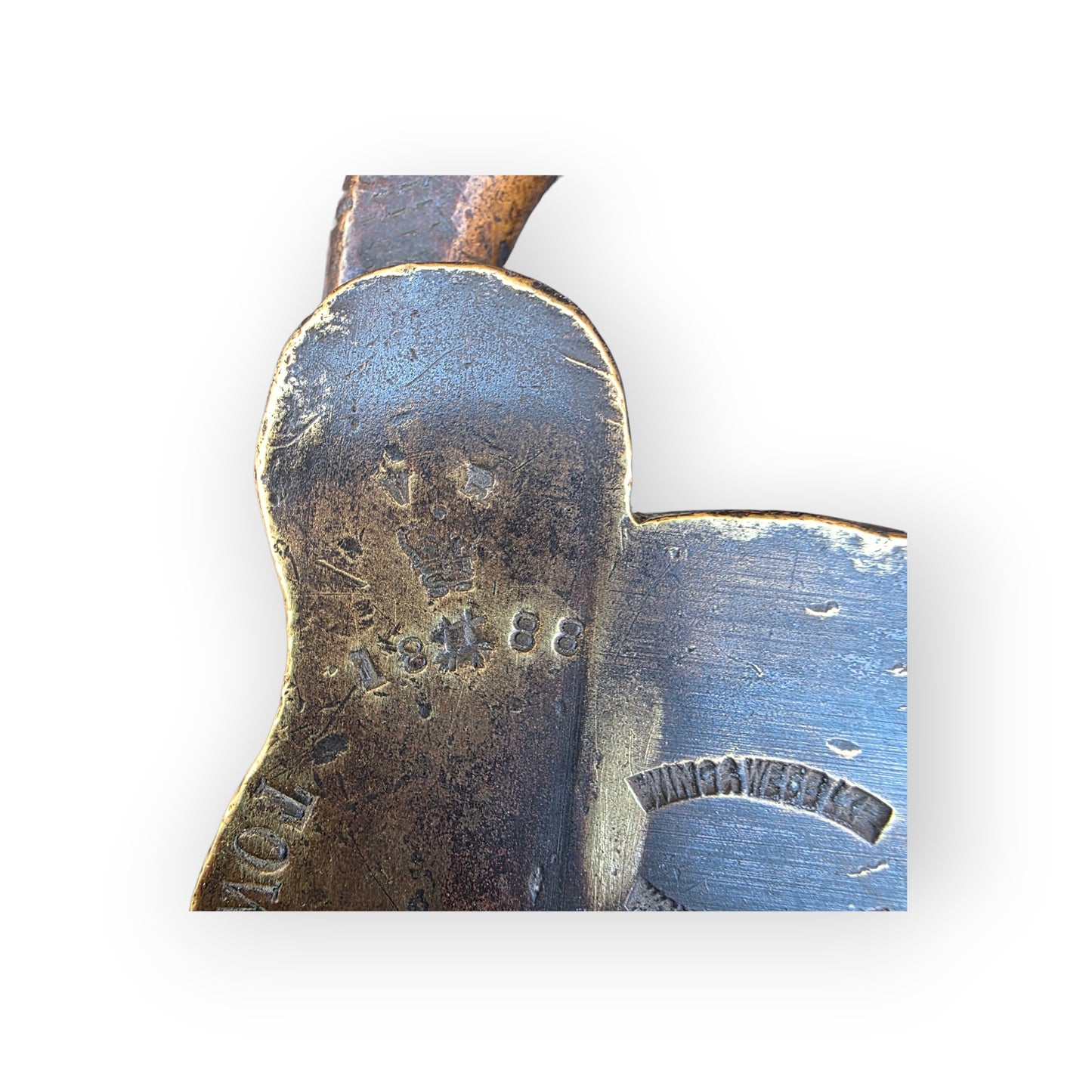
This substantial padlock, cast in heavy brass with a deep, time‑worn patina, would have secured one of the Tower’s raven enclosures—small gated pens used to house the birds when not roaming the grounds. The clearly impressed marks make this an unusually well‑preserved and highly desirable example of Tower‑related hardware.
The form is typical of mid‑to‑late 19th‑century institutional padlocks: thick‑walled brass body, reinforced shoulders, and a robust shackle designed for repeated daily use. Surviving examples with specific departmental or location stamps—especially those referencing the ravens—are exceptionally scarce.
Also bearing the impressed marks:
VR – “Victoria Regina”
The letters VR stand for Victoria Regina, the royal cypher of Queen Victoria (reigned 1837–1901). This mark was used on government‑issued hardware, locks, keys, military equipment, and institutional fittings throughout the Victorian period.
It confirms that the padlock was official Crown property, not a later souvenir or reproduction.
Crown Proof Mark
The small Crown stamp is a standard British government proof mark, applied to items manufactured for state use. It appears on:
Prison locks
Military padlocks
Post Office hardware
Admiralty and War Office equipment
Tower of London fittings
Its presence indicates that the lock passed government inspection and was accepted into official service.
Date Mark: 1888
The 1888 stamp is consistent with late‑Victorian institutional hardware. This date sits perfectly within:
The formalisation of the Tower’s raven‑keeping tradition
A period of major refurbishment and reorganisation at the Tower
The era when numbered raven pens were introduced and maintained
This makes the padlock a textbook late‑Victorian Tower artefact.
Why These Marks Matter
Together, the marks:
VR
Crown proof
1888
“Tower of London – Raven Pen No.2”
form a complete and coherent set of official Victorian government identifiers.
They confirm that the padlock is:
Authentic
Period‑correct
Issued for use within the Tower of London
Directly connected to the raven pens, not a general‑purpose lock repurposed later
This combination is exceptionally rare and highly desirable for collectors of Tower memorabilia, Victorian hardware, and British institutional artefacts.
This is a superb piece of London history, blending folklore, monarchy, and the practical realities of life within the Tower’s walls.
Background: The Ravens of the Tower of London
The presence of ravens at the Tower is one of the most famous traditions in British folklore. According to long‑held legend, “If the ravens leave the Tower, the Kingdom will fall.” Although the story’s roots are partly mythic, the tradition became formalised in the Victorian period, when the Tower began keeping a permanent group of ravens.
Key points of the Raven tradition:
The superstition may date back to the time of Charles II, who insisted that the birds be protected.
By the 19th century, the Tower maintained designated raven pens, each numbered, to house the birds safely at night or during repairs.
The ravens became an official part of the Tower’s identity, cared for by the Yeoman Warders (Beefeaters).
Today, at least six ravens must be kept at all times—an official royal decree.
The birds are wing‑clipped to prevent them from straying too far, and each has a name, personality, and role.
Objects connected to the raven pens—locks, keys, signage, and feeding equipment—are extremely rare survivors and highly sought after by collectors of Tower memorabilia.
This padlock, marked “Raven Pen No.2”, sits squarely within that tradition, making it a museum‑worthy piece of Tower folklore.
Provenance: England. 19th Century. Formerly owned by the Crown. Ex-Private collection - Yorkshire. Bearing the maker's stamp, too - Wing & Webb Ltd, Wolverhampton.
Material: Brass with its original iron key.
Condition: Please refer to the images. The lock hasn't been tested. Excellent antique condition overall with expected wear, patina, and handling marks. Stamping remains clear and legible—a strong, honest example.
Dimensions: 11.5 cm (4.5")
🚚✈️🚢 We ship worldwide!
You can buy with 100% confidence too!
We are a member of the following 4 Professional Associations:
1. LAPADA (London and Provincial Antique Dealers Association) – LAPADA is the UK’s largest trade association for professional art & antique dealers (representing approximately 500 UK dealer members). All items are backed by our LAPADA guarantee;
2. CINOA –Confédération Internationale des Négociants en Oeuvres d'Art, (or International Confederation of Art and Antique Dealers' Associations) is the world association of art & antique dealer associations (representing 5000 dealers from 32 associations in 22 countries);
3. The Norfolk & Suffolk Antique Dealers Association - Representing reputable, high quality antiques dealers based in Norfolk and Suffolk; and
4. FSB - Federation of Small Business.
Wish to purchase this item?
1. Buy online via this website; OR
2. Tel: 00 44 7551 383897 (line open 9.30 am to 5.30 pm Monday to Saturday UK time) where we can take payment over the phone.
Want further information about an item or wish to discuss shipping costs?
1. Email us via this website; OR
2. Email us via:
info@holtantiquefurniture.com
We will aim to respond and make contact with you within 24 hours of receipt of your enquiry.
🚚✈️🚢 Shipping & Customs Information
Please Note: Prices shown exclude customs clearance fees. Where applicable, these charges will be levied directly by your receiving courier, designated importer, or local government authority. These fees vary by destination and are the responsibility of the buyer. For guidance on potential charges, we recommend contacting your local customs office prior to purchase.