Holt Antiques at East Raynham
Late 18th Century English Antique Wrought Iron Bar-Grate Toasting Fork with Turned Handle
Late 18th Century English Antique Wrought Iron Bar-Grate Toasting Fork with Turned Handle
Proud to be members of


Couldn't load pickup availability
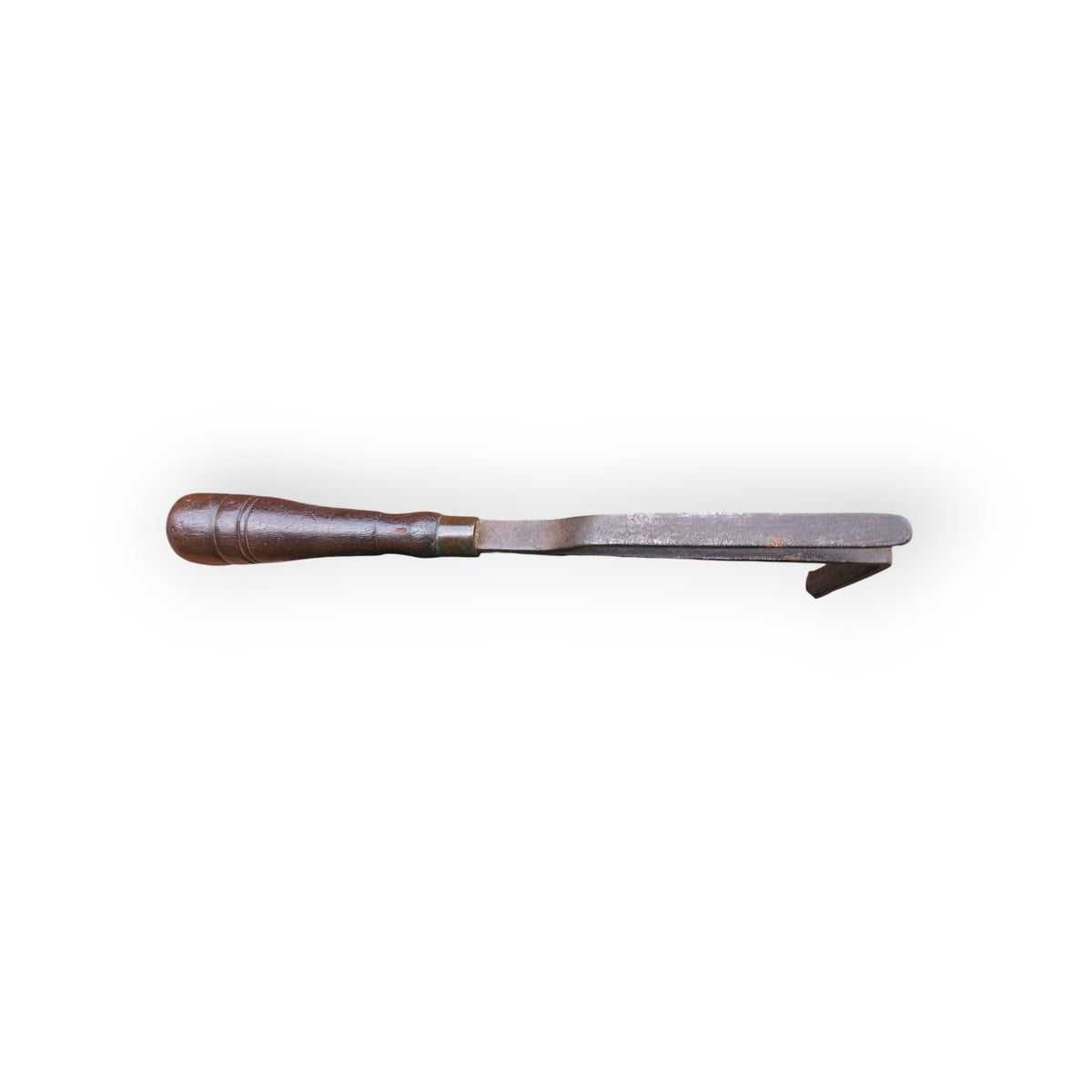
An ingenious hearth tool from the late Georgian fireside. It was made to hang from the top bar of a fire grate, so that bread, muffins, or small cuts of meat were held steadily before the coals and the cook’s hands were left free. Hearths changed in the 18th century from the open down-hearth to the raised bar grate, and a family of small, clever devices grew up to suit the new fire. This is a good, characterful example.
The turned hardwood oak handle has incised rings and ends in a rounded knop. It is held by a brass ferrule. From the ferrule, a flat iron shank runs out and divides into two arms. The shorter upper arm tapers to a slightly upturned tip. The longer lower arm runs on and then drops at a sharp right angle into a short upright stem. At its foot is a cluster of four hooked and curving prongs, set to hold the food upright and facing the heat. The prong head is fixed, not revolving: the smith passed the stem through it and peened it over at the foot. It is a plain, strong joint, made to survive years of heat and use. The gap between the two arms lets the toaster sit astride the top bar of the grate, with the fork hanging in front of the fire. It is an economical piece of design: no stand, no legs, just the grate itself doing the work.
Toasters like this are now scarce. Few people recognise what they are, and many were thrown out once hob grates and kitchen ranges replaced the bar grate. This one would interest anyone who collects early kitchen and hearth equipment. It would also be an engaging talking point beside an inglenook or wood-burning stove.
Provenance: England. Late 18th-century. Ex-private collection.
Material: Hand-forged wrought iron, brass ferrule and turned hardwood handle (probably fruitwood).
Condition: Good, honest condition for its age and use. The iron has an even, dark surface with scattered pitting from old corrosion, most noticeable on the prongs. The prongs are hand-bent and slightly irregular, as made. The peened joint at the prong head is tight. The handle is sound, with a good dark colour and minor knocks and handling marks. The brass ferrule is firm and has an untouched surface.
Dimensions: Length 12½ in (32 cm)
🚚✈️🚢 We ship worldwide!
You can buy with 100% confidence too!
We are a member of the following 4 Professional Associations:
1. LAPADA (London and Provincial Antique Dealers Association) – LAPADA is the UK’s largest trade association for professional art & antique dealers (representing approximately 500 UK dealer members). All items are backed by our LAPADA guarantee;
2. CINOA –Confédération Internationale des Négociants en Oeuvres d'Art, (or International Confederation of Art and Antique Dealers' Associations) is the world association of art & antique dealer associations (representing 5000 dealers from 32 associations in 22 countries);
3. The Norfolk & Suffolk Antique Dealers Association - Representing reputable, high quality antiques dealers based in Norfolk and Suffolk; and
4. FSB - Federation of Small Business.
Wish to purchase this item?
1. Buy online via this website; OR
2. Tel: 00 44 7551 383897 (line open 9.30 am to 5.30 pm Monday to Saturday UK time) where we can take payment over the phone.
Want further information about an item or wish to discuss shipping costs?
1. Email us via this website; OR
2. Email us via:
info@holtantiquefurniture.com
We will aim to respond and make contact with you within 24 hours of receipt of your enquiry.
🚚✈️🚢 Shipping & Customs Information
Please Note: Prices shown exclude customs clearance fees. Where applicable, these charges will be levied directly by your receiving courier, designated importer, or local government authority. These fees vary by destination and are the responsibility of the buyer. For guidance on potential charges, we recommend contacting your local customs office prior to purchase.