Holt Antiques at East Raynham
George III Period, English Antique Ash & Beech Cricket Table of Rare Form
George III Period, English Antique Ash & Beech Cricket Table of Rare Form
Proud to be members of


Couldn't load pickup availability
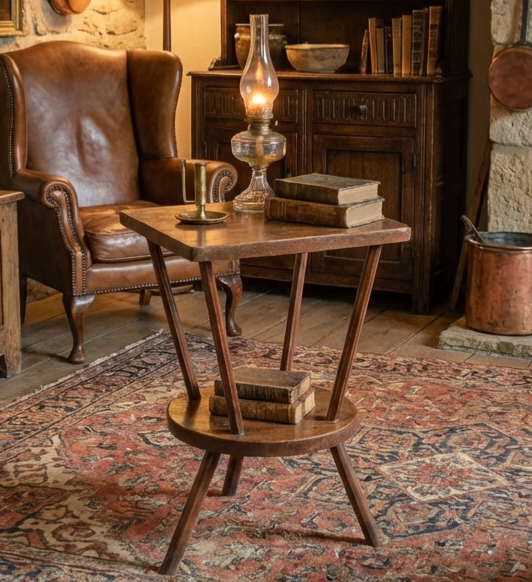
A sculptural and beautifully balanced George III period cricket table, crafted in ash and beech, with a rare and distinctive three‑legged form. Dating to c.1780, this piece embodies the vernacular ingenuity and quiet elegance of English country furniture at the end of the 18th century.
The table features a square top supported by four angled struts, converging into a circular mid‑tier shelf — a hallmark of the cricket table tradition. From this shelf, three splayed legs descend to the floor, giving the piece its classic tripod stance. This configuration ensured stability on uneven stone or timber floors, making such tables indispensable in cottages, farmhouses, and taverns.
The timber has developed a warm, honeyed patina, with visible grain, gentle undulations, and the honest wear of centuries of domestic life. Pegged joints, tool marks, and the dry, tactile surface all confirm its hand‑crafted Georgian origins.
Cricket tables of this square‑top, round‑shelf configuration are notably scarce. The combination suggests a regional workshop variation — a maker confident enough to deviate from the more common circular top while retaining the essential tripod structure.
Historical Origin of Cricket Tables
The term cricket table is believed to derive from the medieval English word cracket or craquet, meaning a three‑legged stool or small tripod table. The word appears in Middle English sources describing simple, functional furniture used in cottages, workshops, and alehouses. Over time, the term evolved into cricket, but the essential meaning remained the same: a compact, stable, three‑legged table designed for uneven floors and everyday domestic tasks.
By the 17th and 18th centuries, cricket tables had become a staple of English rural interiors. Their tripod form prevented wobbling on flagstones or worn timber floors, while the lower shelf provided a convenient place for candles, pipes, or small household items. Their charm lies in their vernacular practicality, regional variations, and the warm patina developed through generations of use.
Provenance: England. Late 18th century.
Material: Ash and beech. Pegged construction.
Condition: Surface wear, fading, and patina consistent with age. Structurally sound. Photos show the actual item.
Dimensions: Height 66.5 cm ( 26”) x Width 43.5 cm (17.7”) x Depth 35.5 cm (14”)
This is a beautifully balanced survivor of Georgian domestic life — practical, poetic, and rich with folk character.
🚚✈️🚢 We ship worldwide!
You can buy with 100% confidence too!
We are a member of the following 4 Professional Associations:
1. LAPADA (London and Provincial Antique Dealers Association) – LAPADA is the UK’s largest trade association for professional art & antique dealers (representing approximately 500 UK dealer members). All items are backed by our LAPADA guarantee;
2. CINOA –Confédération Internationale des Négociants en Oeuvres d'Art, (or International Confederation of Art and Antique Dealers' Associations) is the world association of art & antique dealer associations (representing 5000 dealers from 32 associations in 22 countries);
3. The Norfolk & Suffolk Antique Dealers Association - Representing reputable, high quality antiques dealers based in Norfolk and Suffolk; and
4. FSB - Federation of Small Business.
Wish to purchase this item?
1. Buy online via this website; OR
2. Tel: 00 44 7551 383897 (line open 9.30 am to 5.30 pm Monday to Saturday UK time) where we can take payment over the phone.
Want further information about an item or wish to discuss shipping costs?
1. Email us via this website; OR
2. Email us via:
info@holtantiquefurniture.com
We will aim to respond and make contact with you within 24 hours of receipt of your enquiry.
🚚✈️🚢 Shipping & Customs Information
Please Note: Prices shown exclude customs clearance fees. Where applicable, these charges will be levied directly by your receiving courier, designated importer, or local government authority. These fees vary by destination and are the responsibility of the buyer. For guidance on potential charges, we recommend contacting your local customs office prior to purchase.