Holt Antiques at East Raynham
An 18th-Century Glass Bleeding Bowl Together with a Brass & Steel Fleam by J. Gay of Leeds — An Antique Barber-Surgeon's Phlebotomy Group
An 18th-Century Glass Bleeding Bowl Together with a Brass & Steel Fleam by J. Gay of Leeds — An Antique Barber-Surgeon's Phlebotomy Group
Proud to be members of


Couldn't load pickup availability
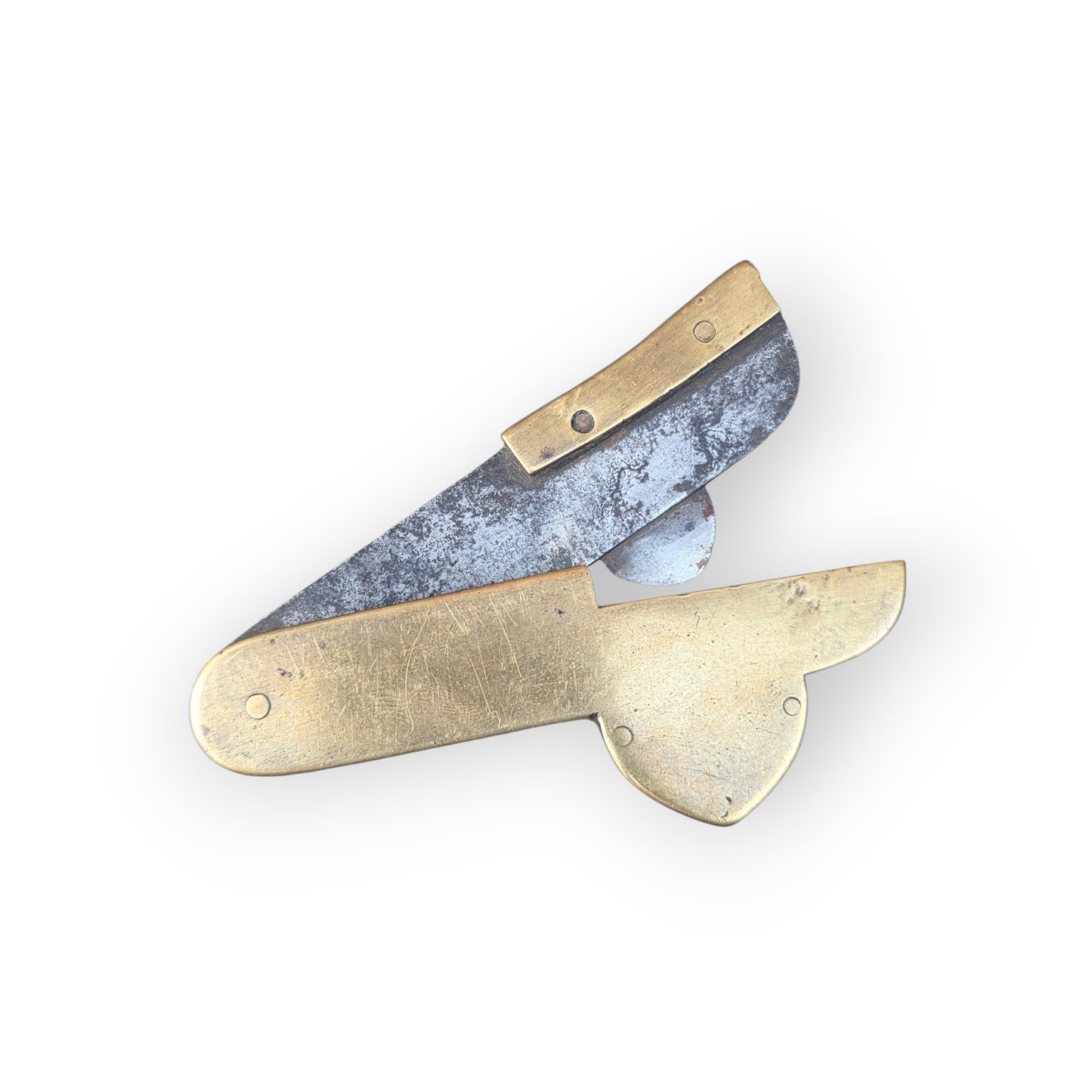
A rare and evocative grouping of antique bloodletting apparatus, bringing together two of the essential instruments of the barber-surgeon's and farrier's art: a free-blown glass globular bleeding bowl of 18th-century date, paired with a brass-mounted folding steel fleam by the Leeds cutler J. Gay.
For the better part of two thousand years, from Galen to the Georgians, venesection — the deliberate opening of a vein to draw blood — stood at the very centre of Western medical practice. It was believed to rebalance the humours, to cool fevers, to relieve congestion and to restore health; and it was performed alike upon people and upon livestock, in the surgeon's premises, the barber's shop and the farmyard. The instruments assembled here speak directly to that long and now-vanished tradition, and together they form a handsome and genuinely interesting historical group.
The Fleam:
The folding fleam is the cutting instrument of the pair. Of characteristic form, it comprises a stout spear-pointed steel blade pivoting from between shaped sheet-brass scales, the blade swung out at a right angle to the body so that it might be positioned over the vein and driven home with a sharp tap of a "bloodstick" or fleam-stick — a method used above all upon horses and cattle, where the jugular was opened for therapeutic bleeding. The brass scales are clearly struck "J. GAY / LEEDS" beneath a crown, with a further roundel maker's stamp to the larger scale. The crown is the loyal/quality device favoured by provincial cutlers, while the second stamp is consistent with a bought-in Sheffield-forged blade finished and retailed under the Leeds maker's own name — a common and entirely period practice. The robust hand-finished construction and spear-form blade point to the first half of the 19th century. The firm of Gay does not appear in the standard published registers of cutlers, making this an unrecorded provincial mark and a rewarding subject for further research.
The Bleeding Bowl:
Offered together as a single phlebotomy group, this is an honest, tactile and historically resonant survival from the age of the barber-surgeon — equally at home in a collection of early medical and veterinary antiques, a cabinet of curiosities, or as a striking conversation piece for the consulting room or study.
The bowl is a small free-blown clear lead or near-clear "green-tinted" glass vessel of compressed globular form, the rounded body drawing in to a short neck and opening to a wide, everted and slightly rolled rim. The objective features that establish its age are all present and visible: the metal carries a faint grey-aqua cast with scattered seed bubbles and striations in the gather; the rim is hand-formed and folded rather than cut or moulded; and — the decisive point — the underside retains a pronounced rough, snapped pontil mark where the punty rod was wrenched away after blowing. There is no moulded seam anywhere on the body. Taken together these are the unmistakable signs of an 18th- to very early 19th-century hand-blown vessel, made before the mould-blown and pressed-glass technologies of the Victorian era.
Functionally, the wide everted mouth and the rounded, free-standing body suit it precisely to its purpose as a receiver — a vessel to catch and hold the blood let from the patient, the broad rim allowing it to be held to the arm or beneath the fleam-cut, the bulbous body giving capacity and a degree of measurement. Plain blown-glass receivers of this kind were the everyday counterpart to the more familiar shallow pewter and Delftware barber's bowls, and being fragile they have survived in far smaller numbers — most were simply broken in use and discarded.
A scholarly note worth making: globular blown vessels of this general form served several closely related purposes in the Georgian household and surgery — as bleeding receivers, as apothecary or leech vessels, and as domestic storage — and absent a fitted lid or specific marking the function is read from form and context rather than proven. What is not in doubt is the quality and date of the glass itself: this is a genuine piece of 18th-century free-blown English glass, and a thoroughly appropriate companion to the fleam.
Provenance: England. 18th and 19th-century. Sourced directly from a private collection of barber-surgeon's tools.
Material: Brass, steel and glass.
Condition: The fleam with overall oxidisation and honest pitting to the steel blade consistent with age and use, the brass scales with a warm mellow patina and the marks clearly legible; the pivot sound and the blade swinging and seating correctly. The glass bowl in perfect condition, free from chips, cracks or losses, retaining its rough snapped pontil and the seed bubbles and faint grey-aqua tint of genuine 18th-century free-blown metal. A clean, honest phlebotomy group in excellent untouched antique condition throughout.
Dimensions:
🚚✈️🚢 We ship worldwide!
You can buy with 100% confidence too!
We are a member of the following 4 Professional Associations:
1. LAPADA (London and Provincial Antique Dealers Association) – LAPADA is the UK’s largest trade association for professional art & antique dealers (representing approximately 500 UK dealer members). All items are backed by our LAPADA guarantee;
2. CINOA –Confédération Internationale des Négociants en Oeuvres d'Art, (or International Confederation of Art and Antique Dealers' Associations) is the world association of art & antique dealer associations (representing 5000 dealers from 32 associations in 22 countries);
3. The Norfolk & Suffolk Antique Dealers Association - Representing reputable, high quality antiques dealers based in Norfolk and Suffolk; and
4. FSB - Federation of Small Business.
Wish to purchase this item?
1. Buy online via this website; OR
2. Tel: 00 44 7551 383897 (line open 9.30 am to 5.30 pm Monday to Saturday UK time) where we can take payment over the phone.
Want further information about an item or wish to discuss shipping costs?
1. Email us via this website; OR
2. Email us via:
info@holtantiquefurniture.com
We will aim to respond and make contact with you within 24 hours of receipt of your enquiry.
🚚✈️🚢 Shipping & Customs Information
Please Note: Prices shown exclude customs clearance fees. Where applicable, these charges will be levied directly by your receiving courier, designated importer, or local government authority. These fees vary by destination and are the responsibility of the buyer. For guidance on potential charges, we recommend contacting your local customs office prior to purchase.