Holt Antiques at Walsingham Mill
Large 19th‑Century Antique Brass Charger / Alms Dish in the 16th‑Century Style – Saint George Slaying the Dragon
Large 19th‑Century Antique Brass Charger / Alms Dish in the 16th‑Century Style – Saint George Slaying the Dragon
Proud to be members of


Couldn't load pickup availability
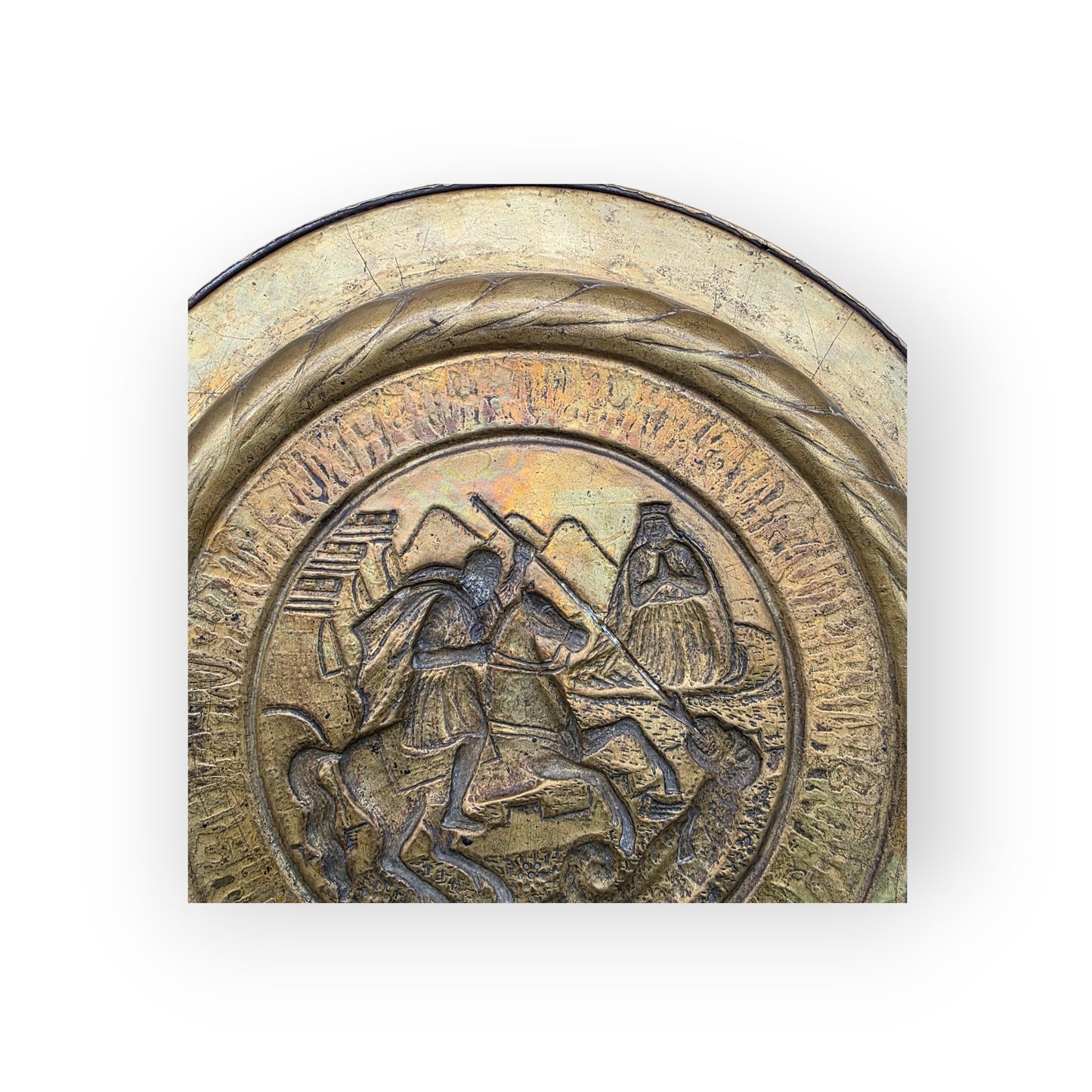
A dramatic 19th‑century brass charger executed in the 16th‑century German Renaissance style, boldly depicting Saint George slaying the dragon. The scene is deeply pressed in repousée-worked relief, showing the armoured saint on horseback driving his lance into the coiled dragon beneath. The composition, with its energetic movement and heroic proportions, draws directly from the martial imagery found on 16th‑century Nuremberg and Augsburg brasswork.
The broad rim, with rolled edge, is decorated with stylised foliate and geometric ornament, echoing the repoussé borders of early German parade chargers. The brass has developed a warm, mellow patina, enhancing the sculptural depth and giving the piece a rich historic presence.
Although inspired by 16th‑century originals, the workmanship and metal quality indicate a 19th‑century revival production, when Renaissance motifs were widely reinterpreted for the decorative market. A superb wall piece or focal point for a collector of arms‑and‑armour imagery, Renaissance revival metalwork, or Saint George iconography.
The Subject Matter and Origin
The Scene: This depicts St. George and the Dragon. St. George is shown on horseback, piercing the dragon with a lance, while the princess (cleverly placed in the background) prays for his victory.
Nuremberg Style: Nuremberg was indeed the world capital for these "alms dishes" (Becken) in the 15th and 16th centuries. However, original Nuremberg dishes almost always featured Gothic or early Renaissance motifs like the Annunciation, the Fall of Man, or simple gadrooning. The specific artistic style of the horse and the figures here feels more aligned with 19th-century romanticism—a "look back" at the medieval period.
The Inscription
The Language: The inscription is not Latin or Old German, which you would find on a Nuremberg dish. It is Church Slavonic (Cyrillic).
Reading the Text: The script is a stylised form of Cyrillic with repeated characters. Notice how the same character clusters repeat around the circle. In original 16th-century brassware, these inscriptions were often "nonsense" or "mock" inscriptions used for decorative purposes by illiterate craftsmen; in the 19th century, they were used to provide "authentic" atmosphere.
What does the translation mean?
The inscription around the central scene is written in Church Slavonic, a liturgical language used by the Orthodox Church. While the script is stylised and repetitive to provide a "Neo-Renaissance" atmosphere, the characters are clearly Cyrillic rather than the Latin or mock-Gothic script found on 16th-century Nuremberg pieces.
Inscription Transcription and Meaning: The text is an identifying or honorific phrase commonly found on icons and metalwork of this saint. In standard Church Slavonic, it typically reads: "СВЯТОЙ ВЕЛИКИЙ ГЕОРГИЙ ПОБЕДОНОСЕЦ" Pronounced "Svyatoy Velikiy Georgiy Pobedonosets." Translated: "Holy Great George the Victorious".
The Repetition: On decorative chargers like this, the potter or engraver often repeats segments of the name or a brief liturgical verse—such as "St. George, help us"—to fill the circular border. This was a common practice in 19th-century Historicist pieces to create a dense, "authentic" visual pattern.
Artistic Details: The central scene, known as the "Miracle of St. George and the Dragon" (Chudo Georgiya o zmie), is rich in Orthodox symbolism:
St. George: Depicted as a triumphant soldier on horseback, piercing the dragon's maw with a lance.
The Princess: Seen kneeling in the background (left), she represents the city of Lacia, saved by the saint's intervention and the power of the Cross.
The Tower: The structure on the right represents the fortress gates or the city watching the miracle unfold.
Why 19th Century?
While it mimics the 17th-century style, several factors point to a later 19th-century date:
The Punchwork: The small decorative punches on the outer rim (the little "fleur-de-lis" and "hook" shapes) are very crisp and uniform, suggesting modern steel stamps rather than the hand-hammered irregularity of the 1600s.
Depth of Relief: The central scene is very high relief and "busy." Authentic 16th/17th-century dishes were usually embossed from the back (repoussé) in a flatter, more stylised manner. This piece looks like it may have been produced using a more modern die-stamping technique to achieve such fine, consistent detail.
In Summary, this is a high-quality 19th-century "Historicist" charger. During the 19th century, there was a massive revival of Renaissance-style metalwork to decorate the homes of the rising middle class.
It remains a very impressive and decorative piece of metalwork, especially given its large size and the crossover between German manufacturing style and Russian iconography.
Provenance: German/Eastern Europe. 19th century. Found within Norfolk, England.
Material: Brass.
Condition: Please see the images. Good overall.
Dimensions: 44.5 cm (17 1/2")
🚚✈️🚢 We ship worldwide!
You can buy with 100% confidence too!
We are a member of the following 4 Professional Associations:
1. LAPADA (London and Provincial Antique Dealers Association) – LAPADA is the UK’s largest trade association for professional art & antique dealers (representing approximately 500 UK dealer members). All items are backed by our LAPADA guarantee;
2. CINOA –Confédération Internationale des Négociants en Oeuvres d'Art, (or International Confederation of Art and Antique Dealers' Associations) is the world association of art & antique dealer associations (representing 5000 dealers from 32 associations in 22 countries);
3. The Norfolk & Suffolk Antique Dealers Association - Representing reputable, high quality antiques dealers based in Norfolk and Suffolk; and
4. FSB - Federation of Small Business.
Wish to purchase this item?
1. Buy online via this website; OR
2. Tel: 00 44 7551 383897 (line open 9.30 am to 5.30 pm Monday to Saturday UK time) where we can take payment over the phone.
Want further information about an item or wish to discuss shipping costs?
1. Email us via this website; OR
2. Email us via:
info@holtantiquefurniture.com
We will aim to respond and make contact with you within 24 hours of receipt of your enquiry.
🚚✈️🚢 Shipping & Customs Information
Please Note: Prices shown exclude customs clearance fees. Where applicable, these charges will be levied directly by your receiving courier, designated importer, or local government authority. These fees vary by destination and are the responsibility of the buyer. For guidance on potential charges, we recommend contacting your local customs office prior to purchase.