Holt Antiques at Walsingham Mill
17th-Century German Antique Stoneware Bellarmine Jug/Bartmannkrug with Marine Concretion - A Seabed Find
17th-Century German Antique Stoneware Bellarmine Jug/Bartmannkrug with Marine Concretion - A Seabed Find
Proud to be members of


Couldn't load pickup availability
A characterful salt-glazed stoneware Bellarmine jug — or Bartmannkrug — of typical bulbous form, the product of the great stoneware potteries at Frechen, near Cologne, in the German Rhineland, and dating to the middle decades of the 17th century, circa 1650–1680.
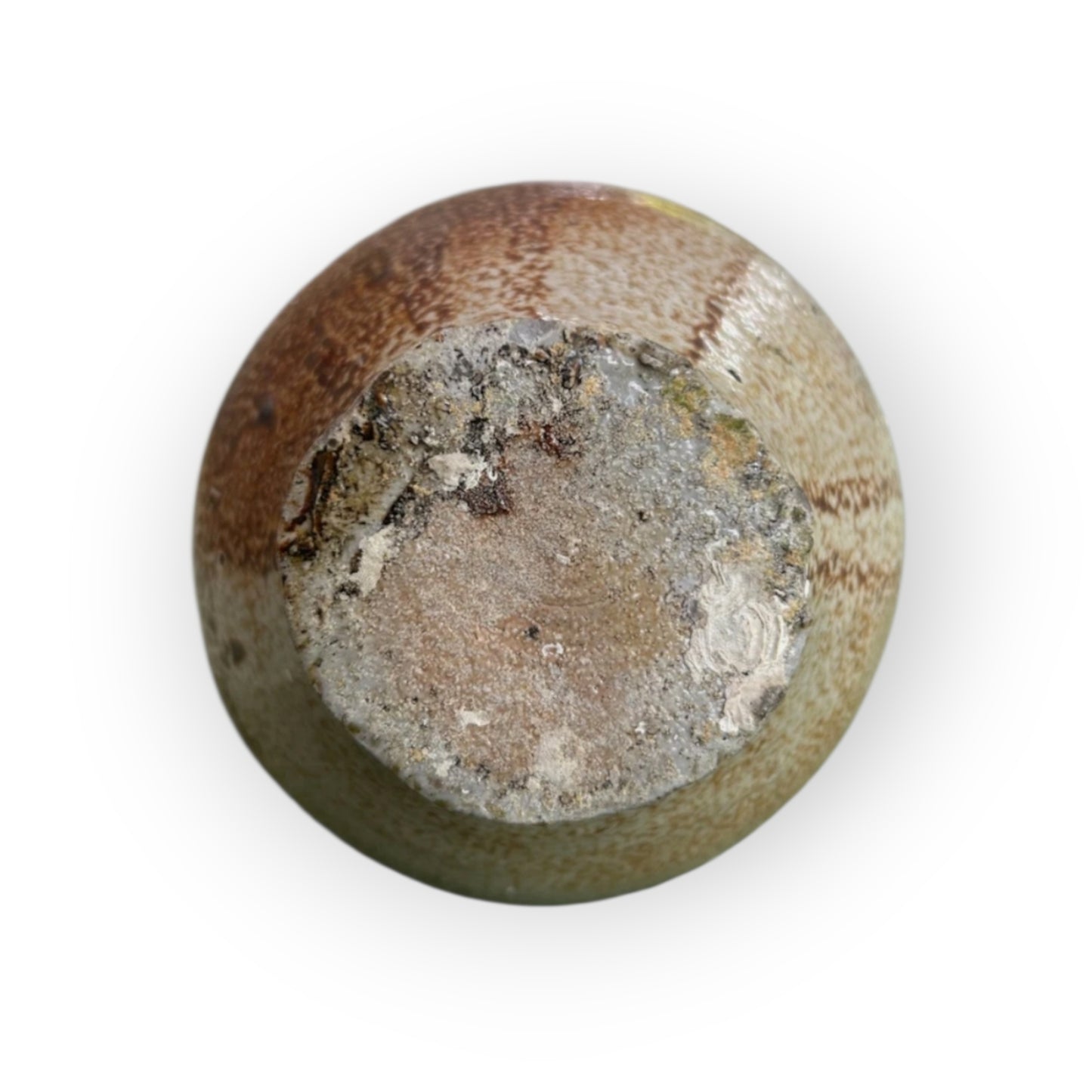
The jug is of compressed globular form, rising to a tall cylindrical neck with a cordoned and slightly everted rim, and fitted with a robust applied strap handle drawn from the shoulder to the neck. It stands upon a pinched and frilled foot-ring. The body is covered overall in the characteristic mottled iron-brown salt glaze — the lustrous, orange-peel "tigerware" surface that has long been prized in this class of ware — shading from deep treacle-brown about the upper body to a paler grey-buff below.
To the front of the neck is applied the moulded bearded mask from which these vessels take their popular English name. The face is rendered in the somewhat schematic manner of the period: a cruciform device to the brow, deeply recessed eyes, a broad nose and pursed mouth, and a luxuriant stylised beard combed into tiered chevrons. The name Bellarmine is an English coinage, fixed — with no little mockery — upon these scowling vessels in dubious honour of Cardinal Robert Bellarmine (1542–1621), the formidable Jesuit theologian of the Counter-Reformation, much loathed in Protestant England and the Low Countries. The Rhenish potters themselves knew the motif simply as the Bartmann, the "bearded man," a descendant of the medieval Wild Man or wodewose of Germanic folklore, moulded onto their wares long before the Cardinal was ever born.
Applied to the body beneath is an oval armorial medallion within a beaded and foliate border, enclosing a crowned heart device. By this date the medallions pressed onto Frechen wares had become largely debased and generic — stock ornamental stamps loosely descended from earlier civic and noble arms rather than meaningful heraldry — and the present example is best understood within that decorative armorial tradition.
This jug is a seabed recovery, and bears the unmistakable signature of long immersion: a dulling and slight etching of the salt glaze, and pale calcareous marine concretion gathered about the neck, the lower body and within the foot. Bartmann jugs of this type were exported in their hundreds of thousands from the Rhineland, down the Rhine to the Low Countries and thence across the North Sea and the Atlantic — the indispensable everyday container of the 17th-century maritime world, carrying wine, beer, vinegar, oil and spirits aboard ship. Great numbers went down with their vessels, and they remain among the most frequently recovered ceramics from North Sea and Channel wrecks. The marine accretion here is no blemish but the very record of the jug's history.
On dry land these same jugs acquired a darker reputation, serving in England as the vessel of choice for the "witch bottle," concealed beneath hearths and thresholds and charged with urine, bent pins and nails as a counter-charm against witchcraft — the bearded mask itself pressed into apotropaic service. This jug, lost instead to the sea, preserves the more workaday story of the trade that made these vessels ubiquitous across early modern Europe.
Provenance: Germany. 17th century.
Material: Salt-glazed stoneware.
Condition: Commensurate with age and maritime recovery: the vessel is complete and structurally sound, retaining its handle and rim, with overall glaze wear, minor losses and flaking, firing pits, and the marine concretion described. Faults are consistent with the piece's history and do not detract from a most evocative survival.
Dimensions: 9 inches (23 cm) high.
🚚✈️🚢 We ship worldwide!
You can buy with 100% confidence too!
We are a member of the following 4 Professional Associations:
1. LAPADA (London and Provincial Antique Dealers Association) – LAPADA is the UK’s largest trade association for professional art & antique dealers (representing approximately 500 UK dealer members). All items are backed by our LAPADA guarantee;
2. CINOA –Confédération Internationale des Négociants en Oeuvres d'Art, (or International Confederation of Art and Antique Dealers' Associations) is the world association of art & antique dealer associations (representing 5000 dealers from 32 associations in 22 countries);
3. The Norfolk & Suffolk Antique Dealers Association - Representing reputable, high quality antiques dealers based in Norfolk and Suffolk; and
4. FSB - Federation of Small Business.
Wish to purchase this item?
1. Buy online via this website; OR
2. Tel: 00 44 7551 383897 (line open 9.30 am to 5.30 pm Monday to Saturday UK time) where we can take payment over the phone.
Want further information about an item or wish to discuss shipping costs?
1. Email us via this website; OR
2. Email us via:
info@holtantiquefurniture.com
We will aim to respond and make contact with you within 24 hours of receipt of your enquiry.
🚚✈️🚢 Shipping & Customs Information
Please Note: Prices shown exclude customs clearance fees. Where applicable, these charges will be levied directly by your receiving courier, designated importer, or local government authority. These fees vary by destination and are the responsibility of the buyer. For guidance on potential charges, we recommend contacting your local customs office prior to purchase.